Sources for this article
Toy group · Uncertain, developed as a breed in Britain and the United States
Chinese Crested
Also called Crested, Powderpuff
A toy breed that arrives in two coats from the same litter, with skin needing as much care as hair.
Two very different looks come out of the same litters in this small companion breed: the Hairless, with silky hair only on its head, tail and feet, and the fully coated Powderpuff. Both are affectionate, playful and rather clingy. Each comes with its own care routine, and understanding that routine is the most important step before choosing one.
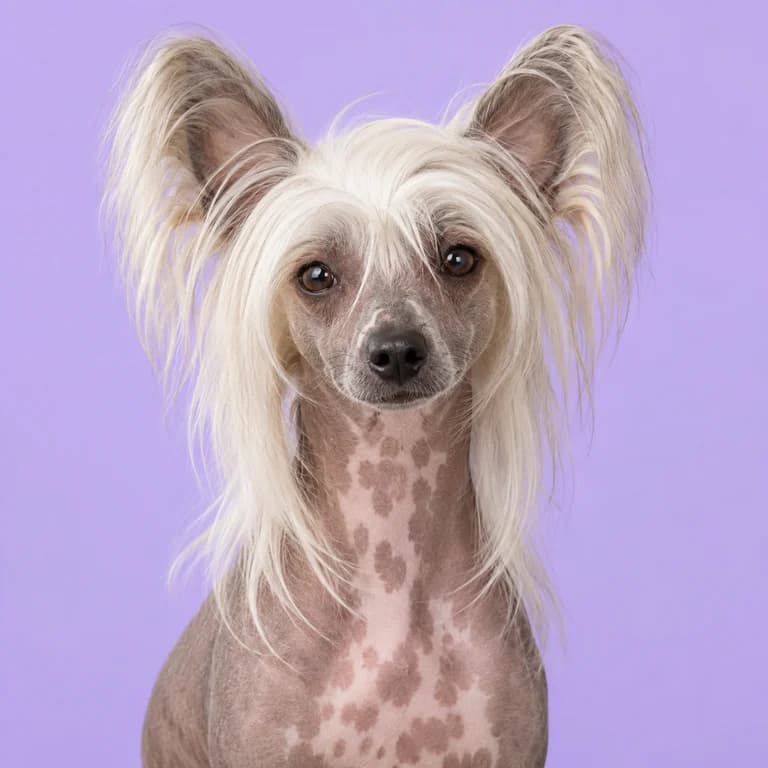
Original AI-generated breed illustration
Weight
3 to 5 kg
7 to 11 lb
Height
23 to 33 cm
at the shoulder
Life expectancy
13 to 16 yrs
Activity estimate
60 to 90 min
editorial daily planning range
Adult-size estimate
10 months
approximate model input
Life with a Chinese Crested
The breed's name promises a story nobody can fully prove. Hairless dogs turn up in several parts of the world, and the Chinese Crested is said to have sailed on Chinese trading ships as a ratter, though genetic work points to links with African or Central American hairless dogs. What is documented is that the breed as we know it was shaped during the twentieth century, largely by British and American enthusiasts, and gained Kennel Club recognition in 1981 and AKC recognition in 1991.
Hairless and Powderpuff are two forms of one breed. The hairless gene is dominant, and a surviving hairless dog always carries one coated copy as well, so any litter from hairless parents can include Powderpuffs. The Hairless has soft bare skin over most of the body, a flowing crest on the head, socks of hair on the feet and a plumed tail. The Powderpuff is covered in fine, silky hair from nose to tail.
Temperament is identical in both. Cresteds are affectionate, alert and deeply attached to one or two people. They seek out warm laps and sunny windowsills, play in short bursts and can be reserved with strangers. Rough games with small children are not their thing, and most do best in a calmer household.
What stands out
Grooming
For the Hairless, skin care replaces brushing. Bathe every one to two weeks with a mild dog shampoo to clear the oils that block pores, rinse thoroughly, and apply a light, non-greasy moisturizer if the skin looks dry. Brush the crest, socks and tail plume two or three times a week.
Read the full grooming guideIllustrative grooming schedule based on our editorial coat-care score. Adjust it to the individual coat and professional advice.
Brushing
4 to 5 times a week
Bathing
Every 3 to 6 weeks
Shedding
Minimal
Nail trim
Every 3 to 4 weeks
A great match for
- apartment living
- owners who are home much of the day
- people wanting a small, affectionate companion
- owners who enjoy a hands-on grooming routine
- adults or families with older, gentle children
Think twice if
- hairless skin needs sun protection and regular washing
- Powderpuff coat mats quickly without brushing
- fragile teeth and early tooth loss in hairless dogs
- prone to separation distress
- feels both cold and heat
Personality and needs at a glance
Living together
Good with children
Good with other dogs
Open with strangers
Apartment friendly
Copes with alone time
Energy and character
Energy level
Playfulness
Easy to train
Barking
5 means very vocal
Care and climate
Grooming needs
Shedding
Drooling
Handles cold
Handles heat
How much a Chinese Crested eats
Illustrative calculations for neutered adults at midpoint breed weights, with food at 370 kcal per 100 g and 100 g per cup. These are not measured breed requirements. Use actual weight, the food label and veterinary body-condition advice.
| Dog | Weight | Calories | Dry food |
|---|---|---|---|
| Female, relaxed lifestyle | 4 kg | 280 kcal | 75 g (0.8 cups) |
| Female, typical pet | 4 kg | 320 kcal | 85 g (0.8 cups) |
| Male, typical pet | 5 kg | 350 kcal | 95 g (1 cups) |
| Male, very active | 5 kg | 430 kcal | 115 g (1.3 cups) |
Care guides for the Chinese Crested
Things owners are often surprised by
- 1Hairless and Powderpuff puppies are often born in the same litter
- 2The gene responsible for hairlessness is also linked to missing or irregular teeth, so many hairless dogs lack some premolars
- 3Hairless skin burns in strong sun much like pale human skin
- 4Adults usually weigh 3.5 to 5.5 kg (8 to 12 lb)
- 5Skin on the hairless variety often darkens in summer and lightens in winter
- 6Despite the name, its true origin is unclear, and the modern breed was shaped mainly by British and American breeders
Chinese Crested questions
Are Chinese Cresteds hypoallergenic?
No dog is fully allergen-free, because allergens come from skin, saliva and dander as well as hair. That said, the Hairless sheds almost nothing, and some allergy sufferers react less to it. Powderpuffs shed a little. If you have allergies, spend several hours with adult dogs of the variety you are considering before committing to a puppy.
Why does my hairless Crested get blackheads?
Hairless skin has open pores and oil glands that clog easily, much like teenage human skin. Blackheads are especially common in young dogs and in those wearing heavy clothing or greasy creams for long periods. Regular bathing with a mild dog shampoo and gentle wiping with a soft cloth help keep pores clear. Spots that turn red, swollen or sore should be looked at by a vet.
Can hairless and Powderpuff puppies come from the same parents?
Yes, and it happens often. Every hairless Crested carries one hairless gene and one coated gene, so two hairless parents can produce both types, and a hairless dog bred to a Powderpuff usually produces a mix too. Two Powderpuff parents produce only Powderpuffs. Both types belong to the same breed and are registered together.
Do Chinese Cresteds need clothes?
In many climates, yes. A hairless Crested has no insulation, so a jumper or fleece coat is sensible once temperatures fall below about 10°C (50°F), and a light sun shirt helps on bright days. Powderpuffs manage cool weather better but still appreciate a raincoat. Choose clothing that fits without rubbing, and take it off indoors so the skin can breathe.
How long do Chinese Cresteds live?
Most live 13 to 16 years, and meeting one older than that is not unusual. Small size helps, but good dental care has a real effect on how comfortably a Crested ages, since tooth trouble is common in the hairless variety. Regular eye examinations also help catch lens problems early, when there are more options available.
Popular answers for owners
- Grooming and coatHow do I get chewing gum out of my dog's fur?
- Bowls and feeding gearWhat size bowl is best for a puppy?
- Grooming and coatCan you brush a dog too much?
- Bowls and feeding gearDo flat faced dogs need a special bowl shape?
- Exercise and playHow much exercise does a working breed need to stay calm indoors?
- Bowls and feeding gearHow often should water bowls be refilled and washed?
Breeds you might compare

Toy group
Miniature Pinscher
4 to 6 kg · 12 to 16 years
A pint-sized escape artist with a high-stepping trot and a mind that is always two moves ahead.

Toy group
Pekingese
3 to 6 kg · 12 to 14 years
A dignified little dog from the Chinese imperial court, whose flat face and heavy coat shape almost every care decision.

Toy group
Pomeranian
2 to 3 kg · 12 to 16 years
A spitz shrunk to under 3 kg that still carries itself like the biggest animal in the room.

Toy group
Bolognese
2 to 4 kg · 12 to 14 years
A quiet, cloud-white Italian companion whose fluffy, open coat needs more care than its low shedding suggests.

Toy group
Toy Poodle
2 to 4 kg · 14 to 17 years
A full Poodle brain packed into a body under 4 kg, quick to learn and quicker to notice your habits.
Toy group
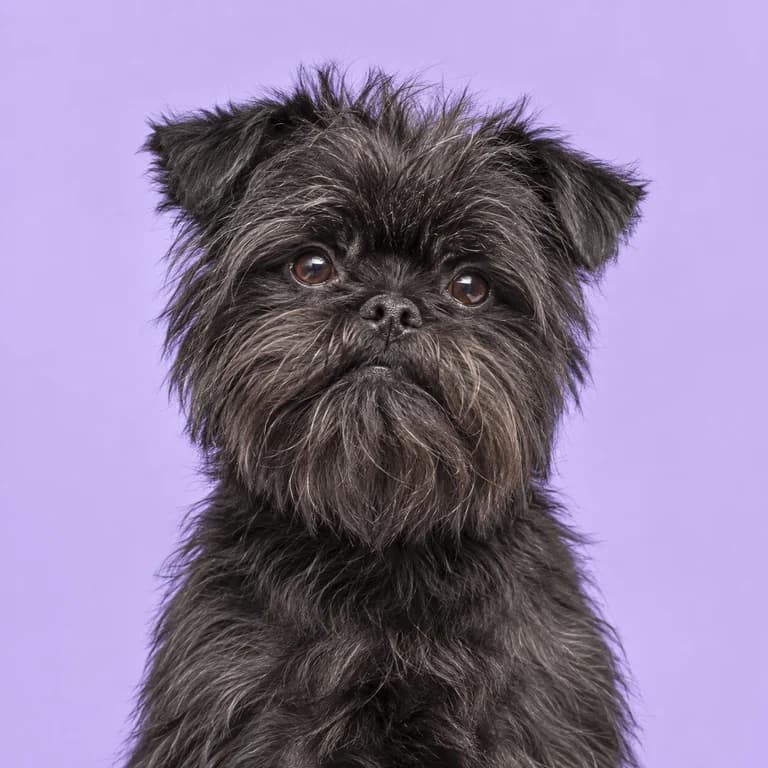
Affenpinscher
3 to 6 kg · 12 to 15 years
Barely 4 kg of confidence, a monkey-faced stable ratter that behaves as if nobody told it how small it is.